
CRIS Launches New Citizenship Efforts
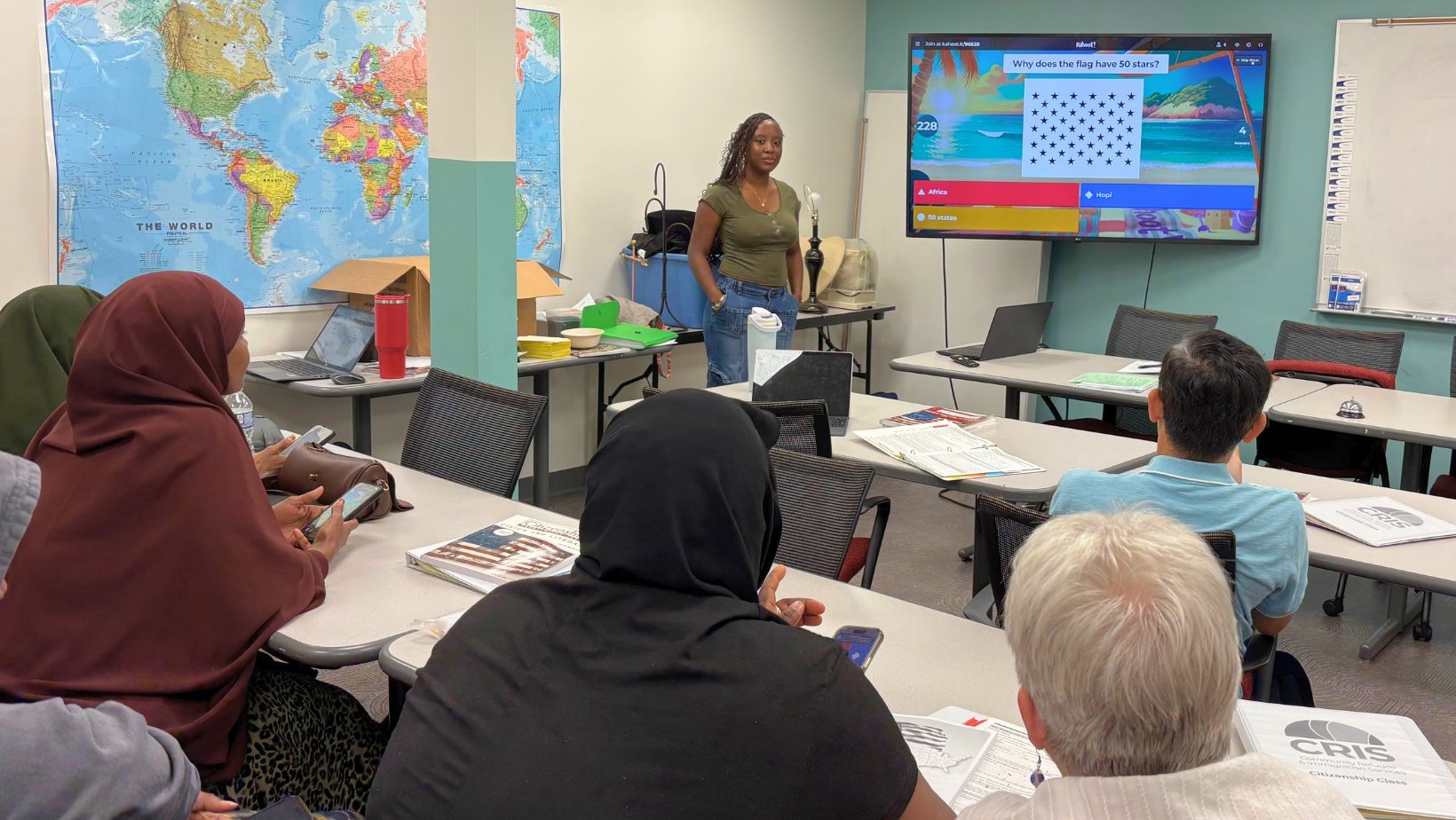
CRIS intern Trenah leads Citizenship class participants in a civics content review
One of the many joyous elements of CRIS’ work is attending a naturalization ceremony, where former refugees and immigrants are sworn in as U.S. citizens. It is a celebration of years of perseverance, sacrifice, and hope. At one such ceremony in Columbus last year, the presiding judge reflected on one of the founding principles of the United States: “We are not all here yet.” In other words, our country continues to grow and become stronger as we welcome people from around the world as new citizens. CRIS’ newly relaunched citizenship program is built on that very notion.
Duy* is a participant in CRIS’ new citizenship class. In his home country, Duy was a physician specializing in hematology, and his wife was a pharmacist. They and their two daughters moved to the United States seven years ago. Duy immediately began taking English classes while he searched for work and his daughters started school. Today, he works in assembly at Honda, and his oldest daughter is entering her third year at The Ohio State University studying pre-medicine, with hopes of becoming a doctor like her father. Duy continues to sharpen his English skills and prepare for the civics portion of the naturalization exam. He is an engaged student in CRIS’ citizenship class and looks forward to the day he completes the naturalization process.
CRIS Legal Services has been helping lawful permanent residents become U.S. citizens for many years by assisting with N-400 applications, conducting practice interviews, and, when needed, accompanying participants to interviews with U.S. Citizenship and Immigration Services (USCIS). As recently as 2023, CRIS also offered USCIS-funded citizenship classes, but the loss of that funding forced the program to close. Thanks to new support from the City of Columbus, CRIS is once again able to offer citizenship classes alongside a new monthly Naturalization Legal Clinic, where eligible individuals can receive guidance through the legal aspects of the naturalization process.
Becoming a U.S. citizen is a significant undertaking. In general, applicants must be lawful permanent residents for at least five years, maintain continuous residence in the United States, complete the N-400 application, pay filing fees, attend biometrics and an interview with USCIS, demonstrate English proficiency, pass a civics exam, and ultimately take the Oath of Allegiance at a naturalization ceremony. This is the path Duy and his classmates are currently navigating—one step at a time.
That journey has become even more challenging over the past year. In August 2025, USCIS released a policy update redefining the “good moral character” requirement for naturalization. The following month, USCIS expanded the civics portion of the naturalization interview, increasing the pool of possible questions from 100 to 128. Instead of answering six of ten questions correctly, applicants must now answer twelve of twenty correctly. Then, in June of this year, the Department of Homeland Security proposed a new fee structure for Form N-400 that would increase filing costs by hundreds of dollars while effectively eliminating fee waivers for many low-income households.
Despite these growing challenges, participants in CRIS’ citizenship classes remain undeterred in their pursuit of U.S. citizenship. Their determination has inspired everyone involved in the program. CRIS citizenship intern Trenah, a senior public policy major at The Ohio State University, shares, “It is inspiring to see the class participants make time and space in their already busy lives—amidst parenting and full-time work and more—to come to class, to study, and to continue to learn.”
CRIS volunteer Karen has attended one citizenship class each week since the program relaunched earlier this summer, while also volunteering with one of our community-based CRIS Clubs in the Hilliard area. She has even begun meeting one-on-one with a participant for additional English and civics practice. Reflecting on the experience, Karen says, “I look forward to it every day. Helping someone towards a goal, helping them get to a better place—it’s so rewarding. I hope that the people we’re working with will feel like they are home here someday.”
For participants like Duy, citizenship represents far more than completing paperwork or passing a test. It is the culmination of years of transition and resilience, and the beginning of a new chapter of belonging. CRIS is honored to walk alongside those we serve on that journey.
Based on current funding, CRIS will continue offering citizenship classes through December of this year. If you or someone you know may be eligible for naturalization and are looking for support, please visit the CRIS Legal Services page for information about our citizenship classes, Naturalization Legal Clinic, and additional legal services.
*Name changed to protect participant privacy.