
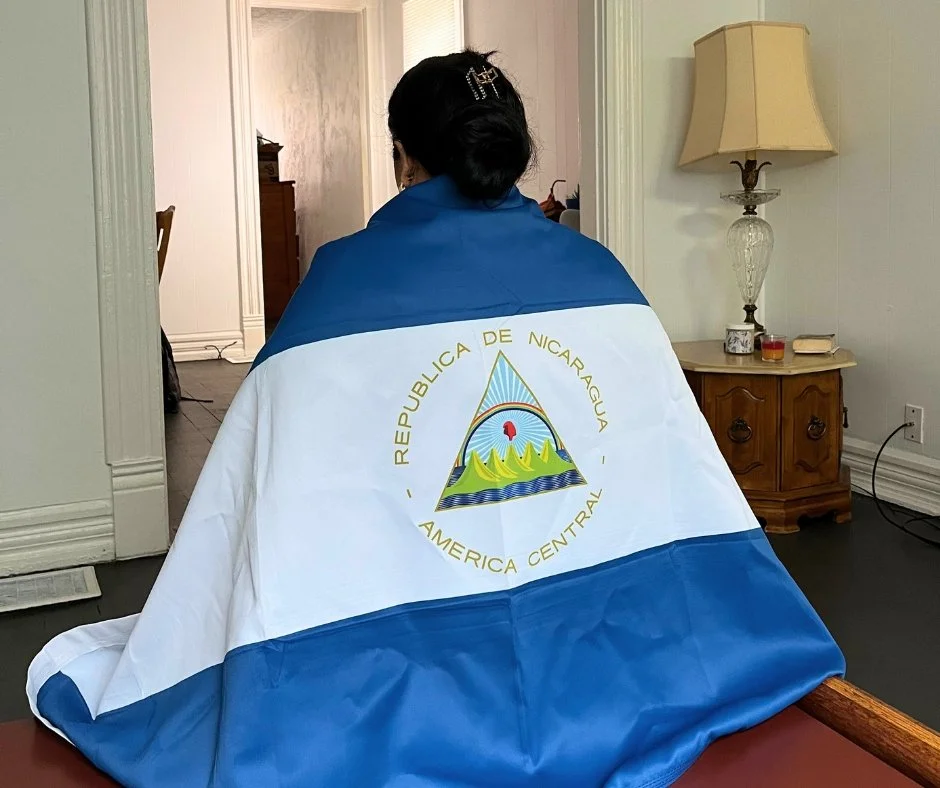
“We weren’t allowed to wave our flag. Not even in our homes.”
In Belen’s (pseudonym) home country of Nicaragua, the flag—once a symbol of pride—had become something dangerous. Just owning one could be seen as an act of protest.
Belen had a typical, happy upbringing in northern Nicaragua. Raised in a loving home, she attended school and went on to earn a degree in tourism management. Her father was a career military man. She grew up hearing stories about her country’s history—how the dictator Somoza had been overthrown in the 1980s, and how Daniel Ortega, a revolutionary leader, had served as president from 1985 to 1990 before being re-elected in 2007.
She was aware of rumors—about increasing authoritarianism, about a growing military presence—but they felt distant from her own life. That changed after college, when she moved to southern Nicaragua for work. There, her understanding of her country’s political reality began to shift.
In April 2018, tensions boiled over. Protests broke out after the government announced cuts to social security, slashing benefits for the elderly. Peaceful demonstrations—many led by senior citizens—were met with shocking military violence. The images and stories triggered an even broader uprising. Belen joined the crowds of citizens demanding change.
On May 30, Mother’s Day in Nicaragua, many took to the streets to continue the peaceful protests, including Belen. What she thought would be a peaceful act of resistance turned into a day of chaos and grief. Hundreds were killed by military gunfire. Belen’s husband, Jacob, was shot in the leg—he still carries the bullet today. His best friend was killed.
With hospitals too dangerous for protestors to enter, Belen and Jacob helped create a makeshift clinic to treat the wounded. “There was no peace, no rest, no protection anymore,” she remembers. By June, daily life had ground to a halt. The military was actively searching for anyone suspected of dissent. She and Jacob hid in a church for safety, until one night in July they made the only decision they felt they had left: to flee.
They crossed into Costa Rica on foot, through the mountains. Others fled with them. But the relief they expected in Costa Rica never came. The government’s promises of support for political refugees quickly faded. Without permanent housing or stable work opportunities, Belen and Jacob struggled to survive. Meanwhile, news circulated that Nicaraguan authorities were targeting exiled protestors even across the border.
While in Costa Rica, Belen received heartbreaking news: her father had died. She would never be able to go home for his funeral. What began as weeks of exile became months, and then years. The repression back home only deepened.
In 2023, they finally got a glimpse of hope. Their application for U.S. resettlement was approved. That October, they arrived in Columbus—and exhaled for the first time in years.
Since then, with support from CRIS, they’ve begun building a safe and stable life. They found jobs at a local hotel, secured an apartment, and are attending English classes. They’ve learned to drive and even bought a car.
Belen and Jacob know the road ahead is long. But for the first time in a long time, it’s a road they can walk in peace. They still hope to see democracy restored in Nicaragua one day. In the meantime, they are deeply grateful for the freedom they’ve found here.