
CRIS 30th Anniversary Story | Intisar
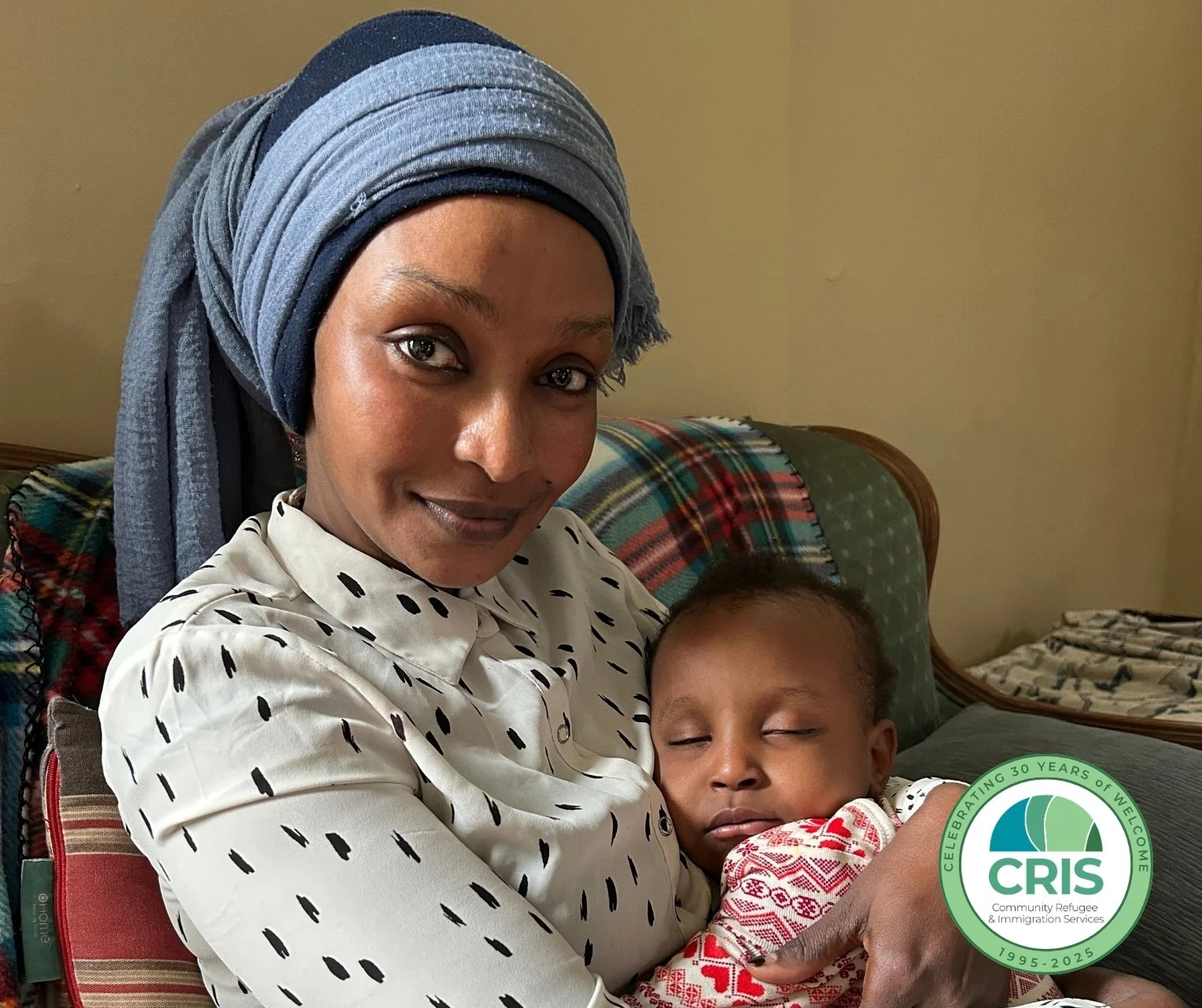
As a young girl growing up in Sudan, Intisar witnessed her father—a physician—literally give the clothes off his back. It was Eid, the joyous holiday that marks the end of a month of fasting for Muslims worldwide. Intisar’s mother had gifted her husband two brand-new outfits for the occasion. But when he encountered a man unable to attend the prayer service for lack of appropriate clothing, he didn’t hesitate. He changed his clothes and gave the man one of his new outfits.
That act of selfless generosity is the example Intisar has carried with her through much adversity.
As war intensified in Sudan, Intisar’s teenage years were overshadowed by instability. At just 15 years old, she fled to Jordan alone in search of safety. There, she lived as a refugee, got married, and began building a life for her growing family. She welcomed her first child, a daughter—followed by not one or two sons, but six! Three years later, she found out she was expecting again, this time with twins! She gave birth to another son two years later—bringing the total to ten children.
While her husband built a successful career in transportation, Intisar stayed home to care for their children, all of whom were able to attend school. Life in Jordan felt stable, but it wasn’t permanent. As refugees, they had no pathway to citizenship, and returning to Sudan was not an option. Third-country resettlement was their only durable solution.
When they were approved to come to the United States, Intisar was overjoyed. Her beloved father had always spoken of America as a land of opportunity. In the fall of 2022, the family arrived in Columbus, where they were welcomed by CRIS then-resettlement case manager Jhuma Acharya and Welcome Team coordinator Teresa Gibson.
Their first challenge was finding a home suitable for their family—and the CRIS team helped them do just that. Intisar and her husband were enrolled in the CRIS Match Grant program, which offered rental support and employment assistance in their first months in the U.S. Not long after arriving, the family grew once more—with the birth of their eleventh child, a baby girl.
The school-aged children began classes, and Intisar’s husband started working. “It was very difficult in the beginning,” she recalls. “Not knowing anyone, not knowing the language—it was challenging.”
Fast forward to today: her children are thriving in school, Intisar works four days a week at a local warehouse, and her English has improved significantly. Life in the U.S.—especially for such a large family—is not without its difficulties, but Intisar is hopeful. She believes in the power of education and opportunity. “If you have a good family, you have a good future,” she says simply.
Her greatest hope is to raise her children to be the kind of person her father was: someone who lifts others up through kindness, compassion, and generosity.
In Loving Memory of My Father
A Tribute from Intisar
“I want to tell you about my father. He was someone who loved all people and always gave them what they needed. It began with our large extended family—my uncles and aunts. I have many aunts and uncles, and every evening after returning from work, my father would check on them.
He was very intelligent and observant. He would go just to greet them and check on the little ones in particular. If he didn’t see one of them, he’d ask, ‘Where is Mohammed?’ He noticed what they needed—and if they didn’t need anything, he’d move on to the next house, and so on.
In our immediate family, he cared deeply about our education. He always made sure we were doing our homework. If he found that we didn’t understand a problem, like me, I struggled with math, he wouldn’t just solve it for us. He would go to the school and ask the teacher to re-teach that problem in class. He believed other students might also be struggling and wanted everyone to benefit, not just one person. The teachers loved him and would sometimes ask me if he had left any notes for them.
When my mother got sick, he cared for her deeply. In Sudan, families are very connected, and everyone supports each other when someone is sick. But my father especially loved taking care of my mother. He would make special meals for her and go to the market to buy her cold juice after every meal, because we didn’t have electricity in our village to keep anything cold.
The government refused to bring electricity to our village because our tribe—the Zaghawa tribe—is strong, and they feared what we could become if we were educated. My father always said the government saw our education as a threat. Even today, my village still doesn’t have electricity or water. That’s another story.
My father loved all of Sudan. No matter which state or region he visited—because we had people in all parts of the country—he would always stop to see how they were doing. He visited hospitals and brought patients whatever they needed: food, medicine, blankets. He visited orphanages and brought food, clothes, books, and toys for the children whose parents had died in war.
He told me that when he helped someone in need, he felt so happy his heart could fly. Every week, he sat with all the children in our family to teach us how to speak and listen to one another. He taught us how to answer respectfully and how to walk properly. He taught us how to respect our parents.
If a parent became upset with us, he would teach us to walk over and kiss their hands and forehead. Even if they were still angry, that gesture softened their hearts. He would ask us later, ‘Where did you learn to do that?’ and we would answer, ‘From you, Dad.’ And he would say, ‘Next time, tell them, ‘This is how my parents raised me.’’
He never took credit for his good deeds. He always gave credit to others.
My father was a great and rare person. I used to say he left this life quickly because God loved him—just as we and everyone else loved him. He taught us to be thankful for all our blessings, starting with the most important ones: our parents, our home, our health, our food, and water. He taught us to count these blessings before anything else.
As children, we counted down the days until we would see him again. Every evening, he sat with us, his children. He had a large garment he would wear at home, and he would wrap us all inside it. We would feel his tenderness, his warmth, his heartbeat, and smell his perfume—he loved perfumes. It always smelled like we were living in a house of perfume. He would tell us stories until we fell asleep inside his clothing, and then he would carry us to bed.
He was always neat and organized. He had a small bag he carried everywhere. Inside, he kept perfume, a watch, a comb, a handkerchief, socks, pens, a notebook, and always a miswak (a traditional tooth-cleaning stick). He never went anywhere without it.
I try to teach my children everything I learned from my father. He was a whole school, a complete education in every aspect of life.
The last time I spoke to my father, he had traveled to another state to help solve a conflict between two families. He got sick while he was there, though he didn’t say so directly. I could hear it in his voice. He never complained when he was sick—he wasn’t like others that way. I told him to see a doctor, but he said, “Let me solve the problem first, and then I will go.”
A few days later, my younger brother traveled to bring him home. My father told him that same day—and it turned out to be our last call—’Tell Intisar that I love her.’ I had told him, ‘Forgive me,’ and he said, ‘I forgive you, and I am happy with you.’ He then went to my mother, and not long after, he passed away in her arms.
We can only say: thank God for giving us a father like my father.
He died, but his goodness lives on. I try to teach my children to be kind to others the way he was. I pray for God’s mercy on my father’s soul.
To everyone who reads this and is touched by his story, thank you.”
—Intisar